A few years ago, I was reading some stories on a speculative fiction website, as I am wont to do. (They say the only people who read short fiction are people who write short fiction, and I am no exception to that rule). On this particular site, they took great pains to announce each stories potential “tiggers”, in a big colourful box with bold letters. And one of them caught my eye. Amongst all the things you might be so terrified of that you couldn’t possibly read on, of all the things that might unsettle you to your very bones, sitting amongst them was a four-word, eleven-syllable phrase I’ve never forgotten. “Don’t read this story,” the website said, with deep sincerity, “if you’re ‘triggered’ by the… disregard for personal autonomy.”
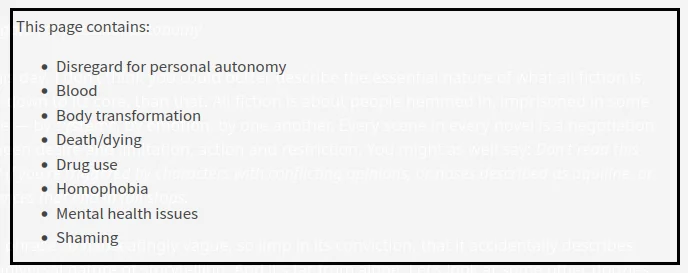
To this day, I don’t think you could better describe the essential nature of what all fiction is, right down to its core, than that. All fiction is about people hemmed in, imprisoned in some sense — by systems, by emotion, by one another. Every scene in every novel is a negotiation between desire and limitation, action and restriction. You might as well say: Don’t read this story if you’re triggered by characters with conflicting opinions, or noses described as aquiline1, or sentences that end in full stops.
It’s a phrase so nauseatingly vague, so limp in its conviction, that it accidentally describes the universal nature of storytelling. And it’s far from alone. Let’s look at some other doozies. “Self-harming behaviours” — I’d love to see that one plastered across the cover of The Catcher in the Rye. “Body transformation” would be a fine fit for Dr. Jekyll and Mr. Hyde . Dysmorphia and abelism are two two other such bloodless phrases. Blood, death, or the very concept of dying are more things you can be sheltered from if you so wish.
To be clear, this is an essay about vague phrasing and the importance of saying what you mean. I make the above points not to draw attention to wet language, but to wet people. The kinds of people that want trigger warnings, and the kinds of people that use them, are boring, flaccid wimps, and for too long we’ve let them normalise this kind of infantilising behaviour.
No. This is not about vague trigger warnings. This is about all trigger warnings. Why they need to get in the bin and why we’d all be so much better of without them.
Safe Spaces
At the heart of all of this is the idea that, as writers, we have some responsibility for the “safety” of our readers, some duty to protect them from harm, that all we’re really doing with trigger warnings is making sure everyone who opens one of our books feels like they’re in a safe, protected space.
Not only do I believe writers have no such responsibility, I believe we have the exact opposite responsibility.
Fiction is supposed to unsettle you. It’s supposed to prod, provoke, and test you. It’s supposed to drag you kicking and screaming to places you didn’t know you were ready to go. It’s supposed to squirm its way into that soft little place in the pit of your stomach where your fears live and start wrecking the place.
Great novels are simulacra of events we’ll never experience and people we’ll never know, fighting battles we will all, at one point or another, have to fight. That is to say: art is a reflection of life. And life doesn’t come with content warnings. You don’t get a handy tip-off before it winds up its right arm and hits you with a fistful of grief, violence, or betrayal. The power of really great literature is that it can help prepare you for those upheavals, not to protect you from them.
That’s the real safe space. The real safety in fiction is in opening yourself up to all manner of horrors, so that when you face them in your own life, you don’t do so alone — but with the experiences, memories, and lessons of those who’ve faced them already.2
And so in this sense, trigger warnings don’t actually make fiction safer. They just reassure people that art will never surprise them. And there’s nothing more dangerous for a person than that.
A Time Tested Divide
The great thing is, there’s already a time-tested divide between what’s appropriate for a reader and what isn’t. When you sit down to write your next great work, when you take up your keyboard, or your pen, or your quill and inkpot if that’s what you’re into, just ask yourself one simple question: Am I writing for children, or am I writing for adults?
If you’re writing for children, you might want to think about the specific age group you’re writing for. You might want to consider the types of challenges they face, and write in a way that feels accessible to them, in language they can relate to. And while you’re doing that, you might also want to give them the benefit of the doubt and assume they can handle more than you think they can.
But if you’re writing for adults, for grown-ass men and women, you might not want to think about any of that. You might not want to think of much more than looking out at the world, or inwards to the darkest corners of your own mind, and writing down the truth about what you see without restriction, and without self-censorship.
That way, we end up with children’s books and adult books. The children’s books you can keep at eye level, easy to reach. The adult books you keep just out of reach (but not so far out of reach that the children can’t climb up on a stool one day and pull them down when nobody’s looking).
Now, you might be thinking: What about trauma? What about victims of abuse? And I have two things to say about that.
First: nobody ever cured their hydrophobia by avoiding water altogether.3 Second: while I am deeply sorry that happened to you, I have no responsibility toward you. You are going to have to make your way in the world as it is. The world has no duty to sanitise itself for your comfort.
But here’s the news, you get a choice. You can lock yourself away, demand trigger warnings, and avoid content that frightens you. Or you can be an adult.
To summarise: you either write for adults or you write for children. And adults should not demand the comforts of a nursery.
The Cultural Cost of Trigger Warnings
I want you to close your eyes and imagine a world where literature exists to confirm and conform to your comforts, a world where every novel comes packaged with a detailed list of every possible thing that might disturb or upset someone.
Imagine a world where we treat books like hazardous materials, plastered with warning labels and moral disclaimers.
Now ask yourself: what kind of world would that be, and who in the blue hell would want to live there?
Because I don’t know about you, but I don’t want to live in a world that flattens books into consumable products instead of works of art. I have zero interest in a culture that teaches readers to approach stories defensively, scanning for potential “harm” instead of opening themselves up to the possibility of transformation.
A disregard for personal autonomy.
That’s what that website I read years ago warned against. And the irony is that this is exactly what the staunch defenders of trigger warnings are advocating for.
They don’t want people to take responsibility for themselves. They want the world turned into a padded playpen, where no one ever risks being knocked sideways, even though a knock to the head is probably what most of them could use.
And to those who say: “It’s just a few sentences for people who need them, you can ignore them if you don’t like them,” I say you might want to turn your head 180 degrees and check over your shoulder, because the point has flown clean over your head.
This isn’t about utility. It’s about a growing infantilisation, specially in online literary spaces, a gradual erosion of resilience under the false banner of kindness. It’s about a culture so addicted to “safety” it’s forgotten that the whole point of art is to sting a little.