Plan, write, track and publish from one Obsidian-based system, with automatic writing analytics and professional export for print and ebook.
You just write. The rest takes care of itself.
How it works
Custom templates and linked notes to map your ideas, characters and worlds, all built around the way Obsidian works. You could spend six months here if you wanted to, planning every minute detail and never writing a word. (I'm sorry if you feel called out by that 😂)
This is where Markdown shines. All the nonsense is stripped away and you just write. There's one button to start your session, one to stop it, and everything else works invisibly in the background.
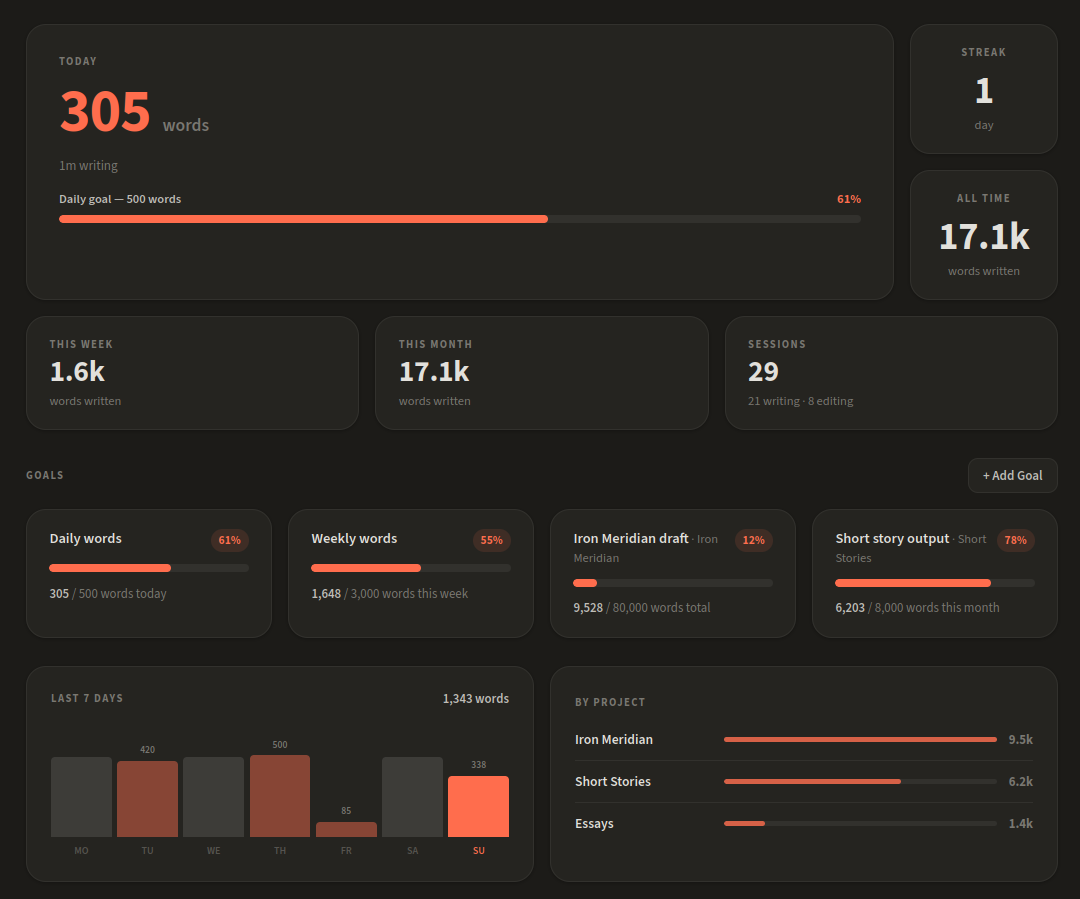
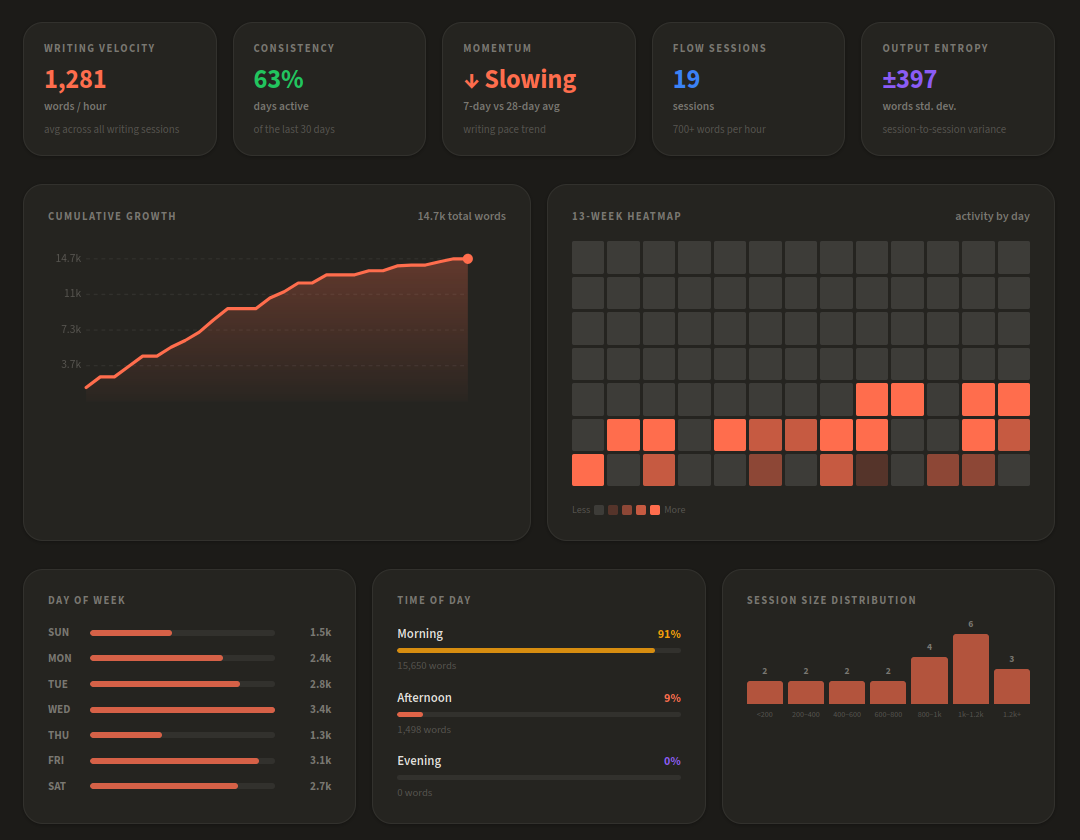
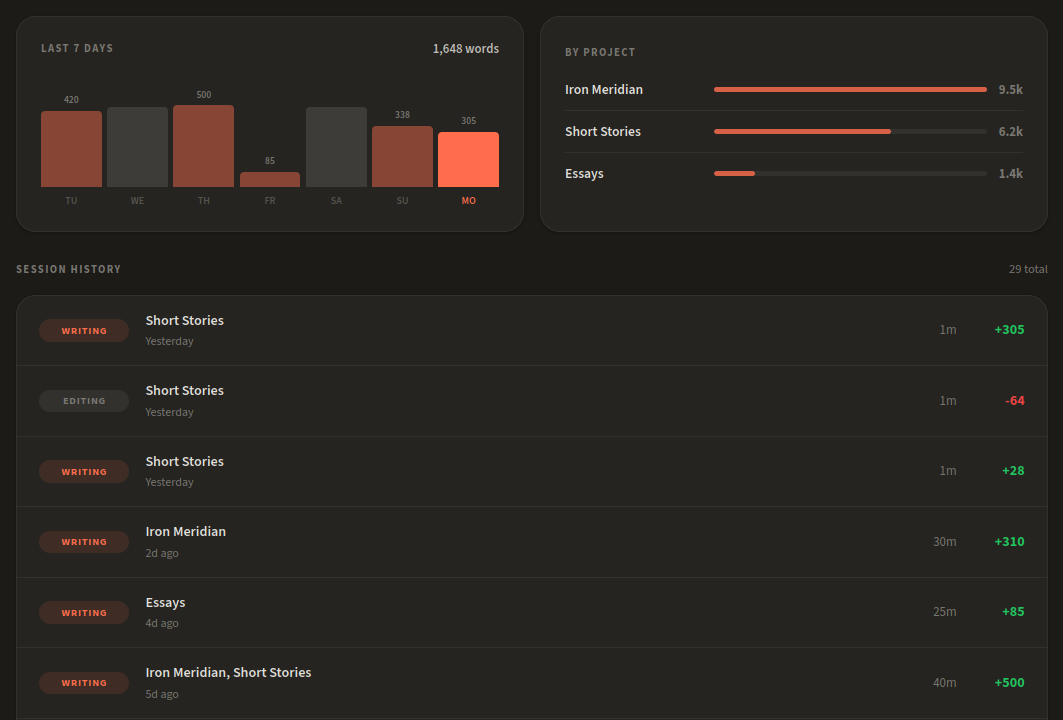
Your own personal, live writing dashboard, accessible anywhere. Beautiful analytics that help you understand your habits, build momentum and improve your output over time. Set yearly, monthly and daily goals, then just get to work. Your writing stays in your vault. Only anonymous session stats are synced to the dash.
Escape the quiet hell of formatting in Word or Google Docs with three powerful export layers. Export a short story in Shunn Manuscript Format, create an EPUB, PDF, or MOBI ebook, or turn your novel into a print-ready book.
Features
Pricing
* Writing Dashboard is hosted live and requires internet access.
Join the WaitlistRoadmap
The next few months are about bringing everything together: testing the tracking and analytics systems, implementing secure user profiles, refining the writing vault and getting the publishing tools ready for real writers to use. Some of it is already built and working (you can download the Shunn Exporter for free from the Obsidian community plugin store right now). Some of it isn't. I'll share progress as I go via the email list and my YouTube channel.
I want EB Writer in writers' hands in time for the start of the new year.
A limited number of Founding Writers will get access first. I don't know exactly how many spots there'll be yet; enough to properly test the system, but few enough that I can listen to everyone using it and make sure everything is working properly before the wider release.
January is for real-world testing. Fix the bugs I didn't find. See how people actually use EB Writer rather than how I imagined they'd use it (or how I'd use it). Listen to Founding Writers and implement the feedback that makes the product better.
EB Writer Free and Writer Plus launch publicly. By this point, the goal is a stable, polished writing system I'm happy putting in front of anyone.
EB Writer isn't something I'm planning to release and forget about. I want to build the writing system I use for the rest of my own writing life, and one I hope you'll want to use for the rest of yours. The way George R. R. Martin feels about WordStar? That's how I want you to feel about EB Writer.
Post launch? I don't know yet. I can think of many things. Deeper long-term analytics. Better publishing tools. New ways to interpret and display years of writing data. But ultimately, it depends on what the community wants.
The principle stays the same: your writing belongs to you, your words stay private, and the software should do its job without getting between you and the work.
FAQ
I fell in love with writing in Markdown almost immediately. Markdown is ultimately just plain text, and isn't dependent on any piece of software to exist. You can work on your story in whatever software you want without any weirdness.
Formatting is super limited in-editor, which is perfect, because you shouldn't be worrying about paragraph spacing when you're writing. But that also comes with obvious limitations when you're a writer who actually publishes things.
EB Writer is my attempt to deal with the limitations of Markdown while capitalising on its strengths. With a few simple rules to follow when you write, you can focus on distraction-free writing, safe in the knowledge that the software can export your work however you need it.
Meanwhile, the open nature of Markdown creates an incredible opportunity for analytics. No closed third-party software. No dealing with limited APIs that break every now and then for no apparent reason.
And finally, if EB Writer ever went away, you'd still have all your words exactly as you left them.
If Markdown is the foundation, Obsidian is the interface, and EB Writer is the magic on top.
Obsidian is an incredible piece of software that's been a go-to for note-taking for a while now. I've heard from loads of writers who say they plan in Obsidian for its linking, metadata and community plugins, but write elsewhere because of its formatting limitations. That's what EB Writer is designed to solve.
And speaking of plugins, they kind of make this whole thing tick. They allow me to write software that lives inside Obsidian itself. Those plugins become the interpretation layer between input and output: they take the Markdown and frontmatter you write and turn it into deep analytics and professional exports.
I used to write in Scrivener. It's great. But the underlying philosophy is completely different.
Scrivener is your entire writing life inside one application, using its own project format. I know first-hand how uncomfortable that can become when you suddenly lose access to the software you rely on.
With the EB Writer–Obsidian system, your work is the foundation. It's local, it's simple, and it's yours. Everything else is just layers on top.
So yes, there's overlap. But EB Writer builds automation, analytics and publishing around ordinary Markdown files rather than asking your writing life to exist inside one writing application.
If EB Writer disappeared tomorrow, your book wouldn't disappear with it.
No. Never. Your writing is always yours, never proprietary, and always local. If you're using Writer Free, that's where it ends.
If you're a Writer Plus user with the writing tracker and live dashboard, EB Writer syncs two things to a secure server. Firstly, your project metadata: title, word count, project status and so on. Secondly, if you choose to track writing sessions, it creates a database entry containing things like session duration, words per session and time of day.
The aim is for it to answer questions like: When am I most productive? How am I doing against my goals this year? How close to completion are my projects?
And then, because I'm a data nerd, that also becomes things like quarterly heat maps, rolling monthly averages, writing speed per session and cumulative growth across the year.
Crucially, if none of this is valuable to you, you don't have to look that deeply. But if you're a bit mad like I am and get a kick out of this stuff, dig in.
Yes. Writing is always offline.
If you're using Writer Plus, your metadata is synced to a secure database and used to populate your private analytics dashboard when you're connected to the internet.
Importantly, session tracking still works offline. EB Writer simply records the data locally and syncs it the next time you're online.
Your writing itself never needs to be uploaded for any of this to work.
No. Obsidian itself is currently free without limits and doesn't require an account. Its paid Sync service is brilliant, but completely optional.
There may be a small learning curve, but no more than with any new piece of software. I found Obsidian extremely intuitive right away, which is part of what drew me to it.
Having said that, I call this a writing system for a reason. There are some key habits and formatting conventions you'll need to follow so that your files are structured in a way the analytics and export tools understand. They're not overly complicated, but they are there. Full written and video guides will be available from Day 1 for maximum clarity.
My design philosophy throughout has been to make the barrier to entry as low as possible. How can I do the most work on my side so that a writer can sit down and focus on writing, while everything else just… happens?
Yes. But…
I don't know where your novel is or how it's structured. So depending on that, your migration to EB Writer will either be completely straightforward or "a little tricky".
I'm 100% planning to make migration guides closer to launch to help with some of the most common scenarios — Scrivener, Word etc. But the good news is that EB Writer is a system, and how your files are organised is a huge part of that system.
Ultimately, migrating your novel becomes a fairly simple question: What format does it currently exist in, and what format does EB Writer expect? The latter will be made extremely clear.
See above. The answer is yes, but it might need a little restructuring into a format EB Writer understands.
Why? Because everyone structures their vaults differently, and part of what makes all of this work is building everything on top of a robust, predictable system.
You won't need to abandon your existing vault. You might just need to teach EB Writer where everything lives.
Yes. Because I want the underlying system to be available to anyone.
If you have no interest in analytics and you're happy formatting your own novels for print, then you don't need Writer Plus. EB Writer will be completely free forever.
You'll still have detailed planning templates, writer-first themes, ebook and Shunn exporters, and a meticulously thought-out system that ties it all together.
Free isn't a trial or a "lite version". It's the entire writing system. Plus is the shiny bits I've built on top.
With Writer Plus, you're paying for a few different things.
First, your private analytics dashboard is hosted online, which costs money to run. There are also the costs of continued development, particularly around analytics, tracking and professional print formatting.
On print formatting, I won't say you're paying for my hair replacement treatment after I pull it all out trying to make the thing work in an elegant, intuitive way, but it'll certainly help.
And Founding Writers get a discount for life because they're taking a chance on this project early.
You'll notice a distinct lack of "AI-powered" features anywhere on this site, which might seem a bit strange for a software product in 2026. That's a completely deliberate choice.
Here's the thing… EB Writer doesn't read your work, generate your prose or send your writing to an AI model. And it never will.
Simply because I think most of what I want to do with EB Writer can be achieved with well-organised data and well-written software. That's really all there is to it.
I'm not going to promise that EB Writer will never contain an AI feature. Technology changes, and so might what writers want from their tools. But if that day comes, it'll be considered feature by feature, with privacy and writer control remaining the guiding principles.
My name is Eason Blackwood. I'm an indie author who loves making tools and resources for other writers, especially the kinds of tools I wish I'd had when I was younger.
Earlier this year I published The 2026 Speculative Fiction Submissions Guide, and I've been building this Obsidian system for the better part of the last six months. (Yes, I know. Anything to avoid actually writing.)
For more on me and my work, head over to easonblackwood.com.
Join the waitlist for early access at the founding price · £5/month or £50/year, locked in for as long as you stay subscribed. Once the founding tier is full, pricing returns to £8/month.
No spam. Unsubscribe anytime.